Small Benefit Exemption Ireland 2026: How to Give Employees €1,500 Tax-Free
With Christmas approaching, many Irish business owners are looking for ways to reward their employees while managing costs effectively.
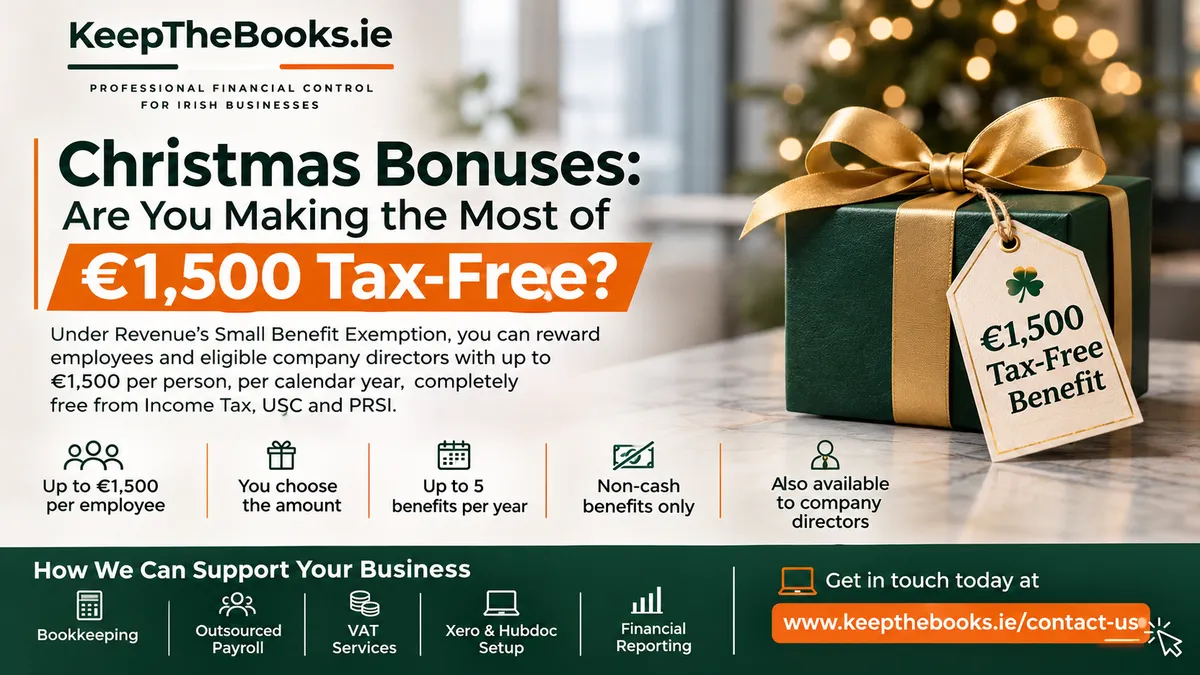
One of the most valuable tax-efficient employee benefits available in Ireland is Revenue’s Small Benefit Exemption, which allows employers to provide eligible employees and company directors with up to €1,500 in tax-free non-cash benefits each calendar year.
Whether you’re considering Christmas gift vouchers, staff rewards or a tax-free benefit for an eligible company director, understanding how the scheme works can help your business make the most of this valuable exemption.
In this guide, we explain the Small Benefit Exemption rules for 2026, which vouchers qualify, how company directors can benefit and what employers need to know about Revenue reporting requirements.
What Is the Small Benefit Exemption in Ireland?
The Small Benefit Exemption is a Revenue-approved tax exemption that allows Irish employers to reward employees with qualifying non-cash benefits without the usual deductions for:
Income Tax (PAYE)
Universal Social Charge (USC)
Pay Related Social Insurance (PRSI)
For 2026, employers can provide up to five qualifying benefits per employee, with a combined annual value of up to €1,500.
This can be a particularly attractive alternative to a traditional cash bonus, which would normally be subject to payroll taxes.
For employees, it means receiving the full value of the qualifying benefit without tax deductions. For employers, it provides a tax-efficient way to recognise staff contributions and reward performance.
How Much Can Employers Give Tax-Free in 2026?
The maximum tax-free allowance under the Small Benefit Exemption is €1,500 per eligible employee, per calendar year.
However, businesses are not required to use the full allowance.
For example, an employer could choose to provide:
Christmas Gift | Tax-Free Value |
|---|---|
Small staff gift | €100 |
Employee appreciation voucher | €250 |
Christmas bonus voucher | €500 |
Senior employee reward | €1,000 |
Maximum annual allowance | €1,500 |
All of these examples can qualify for tax-free treatment, provided the relevant Revenue conditions are satisfied and the employee has sufficient unused allowance.
The scheme also allows employers to spread qualifying benefits throughout the year rather than providing one large Christmas gift.
Important: If an individual benefit exceeds €1,500, the entire value of that benefit becomes taxable. Where multiple benefits are provided, the annual cumulative limit and five-benefit restriction must be respected.
Can Company Directors Receive the €1,500 Tax-Free Benefit?
Yes. Eligible company directors can also avail of the Small Benefit Exemption.
This is particularly relevant for owner-managed Irish limited companies, where directors may wish to provide themselves with a qualifying non-cash benefit.
For example, an eligible director of an Irish limited company may be able to receive a €1,500 gift voucher tax-free, provided all the relevant conditions are met.
However, the exemption should not be confused with a general tax-free withdrawal of company funds.
Directors must satisfy the relevant conditions, and the benefit must be provided through the appropriate company arrangements.
Sole traders should also be aware that they cannot simply claim the exemption for themselves as self-employed business owners.
If you’re unsure whether you qualify, seek professional advice before purchasing vouchers or processing director benefits.
What Gift Cards and Vouchers Qualify?
Gift cards and vouchers are among the most popular ways for Irish employers to use the Small Benefit Exemption.
Common options include:
One4all gift cards: A flexible option accepted by a wide range of participating retailers.
CleverCards: Digital gift card solutions that may offer employers a convenient way to distribute employee rewards.
Retailer-specific gift vouchers: Vouchers for individual shops, supermarkets or other retailers.
Other qualifying non-cash gifts: Certain goods or benefits that satisfy Revenue’s requirements.
The key requirement is that the benefit must not be cash or redeemable for cash, either fully or partially.
Employers should check the terms of any gift card or voucher before purchasing it to ensure it qualifies under Revenue’s rules.
Why Christmas Is a Popular Time to Use the Small Benefit Exemption
Christmas is traditionally a time when Irish businesses recognise employees for their contributions throughout the year.
Rather than paying a conventional cash Christmas bonus, employers may choose to provide qualifying tax-free vouchers.
For example, a hospitality business with 10 employees could provide each employee with a €300 Christmas gift voucher.
That would represent €3,000 in employee rewards, with the full €300 value received tax-free by each employee, assuming all scheme conditions are met.
The same approach can work for businesses operating in construction, manufacturing, e-commerce, retail, equine, professional services and many other sectors.
For employers, the Small Benefit Exemption offers a practical way to recognise employees while managing payroll-related costs.
Do Employers Need to Report Gift Vouchers to Revenue?
Yes.
Under Revenue’s Enhanced Reporting Requirements (ERR), Irish employers must report qualifying Small Benefit Exemption benefits to Revenue.
This reporting must be completed on or before the date the benefit is provided.
Employers are required to report the relevant benefit date and value.
Businesses should also maintain appropriate records of benefits provided throughout the year to ensure they do not exceed the annual allowance or the maximum number of qualifying benefits.
Failure to manage these requirements correctly can create unnecessary payroll and tax compliance issues.
Working with an experienced outsourced payroll provider can help ensure these obligations are handled correctly.
Common Small Benefit Exemption Mistakes to Avoid
Although the scheme is relatively straightforward, employers should avoid several common mistakes.
1. Providing cash instead of qualifying benefits
Cash payments do not qualify for the exemption and are generally subject to normal payroll deductions.
2. Exceeding the €1,500 annual allowance
A benefit that causes the cumulative allowance to be exceeded may become taxable in full.
3. Providing more than five benefits
Only the first five qualifying benefits within the permitted limits can receive the exemption.
4. Forgetting benefits provided earlier in the year
Christmas vouchers must be considered alongside any qualifying benefits already provided during the same calendar year.
5. Failing to report benefits to Revenue
Qualifying benefits must be reported under ERR on or before the date they’re provided.
6. Replacing existing salary or cash entitlements
The scheme cannot be used to substitute normal salary or an existing contractual cash entitlement.
Taking a few minutes to review these requirements can help employers avoid costly mistakes.
Frequently Asked Questions
Is the Small Benefit Exemption €1,500 in Ireland for 2026?
Yes. The maximum annual allowance is €1,500 per eligible employee, subject to a limit of five qualifying non-cash benefits.
Can I give an employee a €500 Christmas voucher tax-free?
Yes, provided the voucher qualifies, the employee has sufficient remaining allowance and the other Revenue conditions are satisfied.
Can a company director receive a €1,500 One4all voucher?
An eligible company director may receive a qualifying €1,500 voucher tax-free, subject to the applicable Revenue rules.
Can I give employees cash instead of vouchers?
No. Cash payments do not qualify for the Small Benefit Exemption.
Can I give different employees different voucher amounts?
Generally, yes. Employers can decide how much to award individual employees, subject to employment law, contractual obligations and the scheme’s tax conditions.
Does the €1,500 allowance carry over into the following year?
No. Any unused allowance expires at the end of the calendar year.
Are Christmas bonuses tax-free in Ireland?
Traditional cash Christmas bonuses are generally taxable through payroll. However, qualifying non-cash Christmas benefits may be exempt under the Small Benefit Exemption.
Professional Bookkeeping, Payroll and Tax Compliance for Irish Businesses
At Keep The Books, we provide professional outsourced bookkeeping, payroll and financial management services to businesses throughout Ireland.
We work with companies across a wide range of industries, including hospitality, construction, e-commerce, manufacturing, equine, retail and professional services.
Our services include:
Outsourced Payroll Services
Complete payroll processing, employee payslips, payroll software setup, Revenue submissions and ongoing payroll compliance.
Bookkeeping and Bank Reconciliations
Professional bookkeeping, purchase and sales invoice management, accounts payable and receivable, and bank reconciliations.
VAT Returns and Compliance
VAT calculations, VAT return preparation and submission, and ongoing support with Irish VAT compliance.
Relevant Contracts Tax (RCT)
RCT compliance, subcontractor payment notifications, RCT returns and support for businesses operating in the construction sector.
Xero and Hubdoc Cloud Accounting
Setup, migration and ongoing support with modern cloud accounting systems, including Xero and Hubdoc.
Management Accounts and Financial Reporting
Regular profit and loss reporting, cash flow reporting and management accounts to help business owners understand their financial performance.
Whether you operate a growing hospitality business, manage construction projects, run an e-commerce company or oversee an established Irish SME, our team can help simplify your financial administration.
Looking for an Outsourced Bookkeeping or Payroll Provider in Ireland?
Managing bookkeeping, payroll, VAT and Revenue compliance doesn’t need to take up your valuable time.
At Keep The Books, we help Irish business owners stay organised, compliant and in control of their finances, allowing them to focus on running and growing their businesses.
Get in touch with our team today to find out how we can support your business.
Visit: https://keepthebooks.ie/contact-us
Keep The Books
Professional Financial Control for Irish Businesses
Disclaimer: This article provides general information based on Revenue guidance for 2026 and does not constitute individual tax advice. Eligibility and tax treatment depend on the circumstances and conditions of each benefit.