
Bookkeeping for Service Businesses in Ireland: The Complete Guide
Running a service business in Ireland means you already have a lot on your plate. You are serving clients, managing your team, chasing invoices, and trying to grow the last thing you want is for your finances to become a mess behind the scenes. But that is exactly what happens when bookkeeping gets neglected. Whether you run a consultancy, a marketing agency, a cleaning company, or any other service-based business, professional bookkeeping is not optional. It is the financial infrastructure your entire operation depends on.
This guide covers everything Irish service businesses need to know what bookkeeping involves, why service firms have unique financial needs, how the right software and processes make a difference, and what to look for when choosing a bookkeeping partner.
What Is Bookkeeping for Service Businesses?
Bookkeeping is the ongoing process of recording, organising, and maintaining all financial transactions within a business. For service-based businesses specifically, this means managing client invoices, tracking business expenses, processing payroll, handling VAT obligations, reconciling bank accounts, and producing accurate financial reports on a regular basis.
The goal is not simply compliance though that matters enormously. The real purpose of good bookkeeping is to give business owners a clear, reliable, and up-to-date picture of their financial position so they can make confident decisions at every stage of growth.
Unlike product businesses, service firms do not deal with stock or inventory. Your core asset is time, expertise, and people. But that does not make the finances simple. In many cases, the financial administration of a service-based business is more complex than most owners expect and the cost of getting it wrong is higher than most realise.
Why Service-Based Businesses Have Unique Bookkeeping Challenges
Service providers face a specific set of financial challenges that product businesses simply do not encounter in the same way. Understanding these challenges is the first step to managing them properly.
Variable Monthly Income
Service firms particularly those working on project-based or retainer arrangements often experience significant fluctuations in monthly revenue. A strong quarter can be followed by a quiet month, and without accurate cash flow forecasting, this variability creates serious uncertainty. Knowing your projected cash position weeks ahead is not a luxury it is a core financial discipline.
Multiple Clients and Invoice Management
A service business with ten or more active clients has ten or more separate invoice streams to manage. Each client may have different payment terms, billing cycles, and agreement structures. Without tight accounts receivable management, overdue invoices accumulate quietly, cash slows down, and the business feels tighter than it needs to.
Payroll Compliance
Once a service business takes on employees, payroll becomes one of the most critical ongoing responsibilities. PAYE, PRSI, USC, employer contributions, sick leave obligations under the Sick Leave Act 2022, and payslip management must all be handled accurately and on time. Errors in payroll are expensive to correct, carry compliance risk, and damage employee trust.
VAT Obligations
Most service businesses in Ireland are VAT registered and must file VAT returns bi-monthly, quarterly, or annually depending on their registration type. Managing VAT correctly knowing what is VATable, recording transactions accurately, and submitting returns on time requires consistent attention throughout the year, not just at quarter end.
RCT for Subcontractors
Service businesses that engage subcontractors particularly in construction, landscaping, maintenance, and related sectors are subject to Relevant Contracts Tax obligations. RCT requires contract notifications to Revenue, correct deduction rates applied to payments, and monthly RCT return filings. Non-compliance in this area carries significant surcharges.
What Professional Bookkeeping Covers for Service Firms
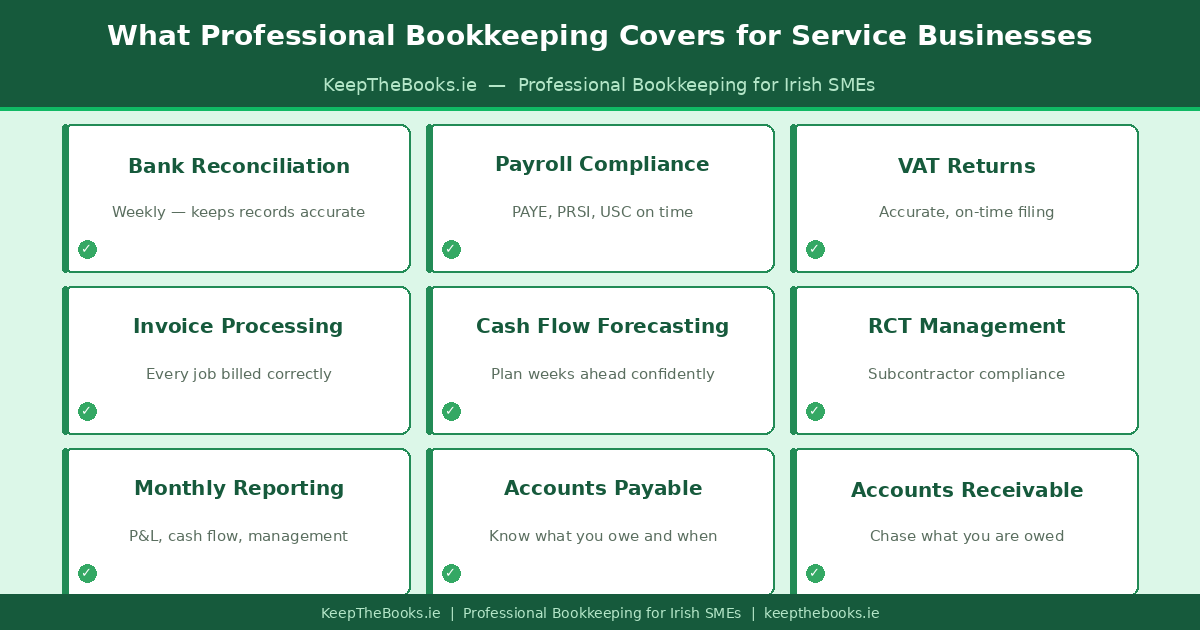
A full bookkeeping service for Irish service-based businesses typically covers the following functions. Each one plays a specific role in keeping your finances accurate, compliant, and useful.
Bank Reconciliation
Weekly bank reconciliation ensures every transaction in your accounting system matches your actual bank records. It is the most fundamental check in bookkeeping without it, errors go undetected, cash flow reports become unreliable, and financial decisions get made on inaccurate data.
Accounts Payable and Receivable
Managing what you owe and what you are owed and when sits at the heart of cash flow management. Professional bookkeeping keeps both sides of this equation organised, flags overdue payments, and ensures nothing slips through the cracks.
Invoice Processing and Management
Accurate and timely invoice processing ensures that every piece of work completed is billed correctly and promptly. In service businesses, delayed invoicing directly means delayed income. Proper invoice management keeps revenue flowing and gives you a clear picture of outstanding payments at all times.
Payroll Processing and Compliance
Payroll for service businesses covers employer PRSI, PAYE, USC calculations, payslip generation, pension contributions, and Revenue returns. A professional bookkeeper handles all of this on schedule, ensuring your team is paid correctly and your business remains fully compliant with Irish payroll legislation.
VAT Returns and Filing
Correct VAT management means every VATable transaction is recorded accurately, input tax credits are maximised, and returns are filed on time. A missed or incorrect VAT return triggers interest charges from Revenue and, in some cases, audit risk. Professional bookkeeping eliminates this exposure entirely.
RCT Filing and Management
For service businesses with subcontractors, RCT compliance is non-negotiable. This includes contract notifications, correct deduction rates, monthly filings, and accurate subcontractor payment records. A professional bookkeeper manages this process from start to finish.
Monthly Financial Reporting
Profit and loss reports and cash flow statements should be produced every month, not just at year end. Monthly reporting gives you the visibility to catch problems early, understand your actual margins, identify your most profitable client relationships, and make decisions based on real financial data.
Cash Flow Forecasting
For service firms with variable income, cash flow forecasting models where your business will be financially in the coming weeks and months. This allows you to plan hiring, manage quiet periods, time investments, and avoid being caught short by a slow-paying client or an unexpected expense.
Bookkeeping Software for Service Businesses in Ireland
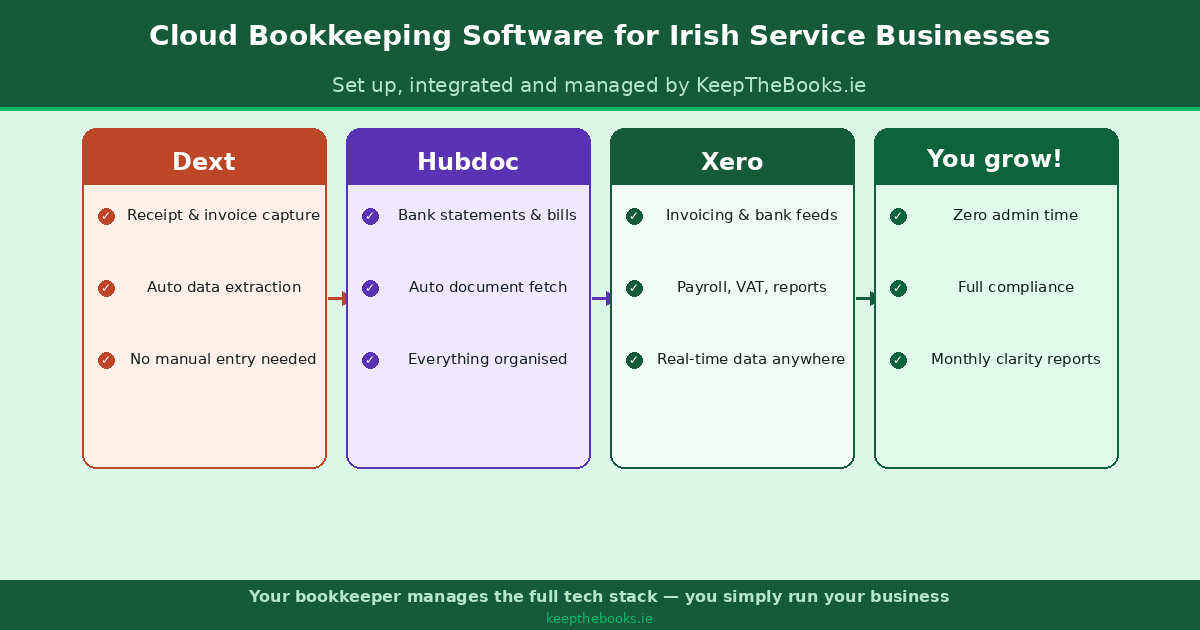
The right accounting software properly set up and consistently managed transforms bookkeeping from a burden into a genuine business asset.
Xero
Xero is the most widely used cloud accounting platform among Irish SMEs and is particularly well-suited to service businesses. It handles invoicing, bank feeds, payroll, VAT returns, and financial reporting in a single system, accessible from any device in real time. For service business owners who want visibility of their finances without being buried in spreadsheets, Xero is the gold standard.
Dext
Dext integrates directly with Xero and automates the capture of receipts and supplier invoices. Business owners photograph receipts or forward invoices by email, and Dext extracts and categorises the data automatically eliminating manual data entry and significantly reducing the risk of errors. For busy service business owners managing multiple expenses across multiple projects, Dext saves considerable time every week.
Hubdoc
Hubdoc automates the collection of bank statements, utility bills, and supplier documents, pulling them from provider portals and storing them in one organised location. It integrates with Xero and ensures your bookkeeper always has the documentation they need without you having to manually compile and send it.
QuickBooks
QuickBooks is another strong option for Irish service businesses, particularly those already familiar with the platform. It provides solid invoicing, payroll, VAT, and reporting functionality and integrates with a wide range of business tools.
A professional bookkeeper will assess your specific business and recommend the right combination of tools. The technology only delivers its full value when it is correctly configured, actively managed, and integrated properly with your workflows.
The Real Cost of Managing Bookkeeping Yourself
Many service business owners handle their own bookkeeping in the early stages to save money. It is understandable. But in most cases, it costs considerably more than it saves.
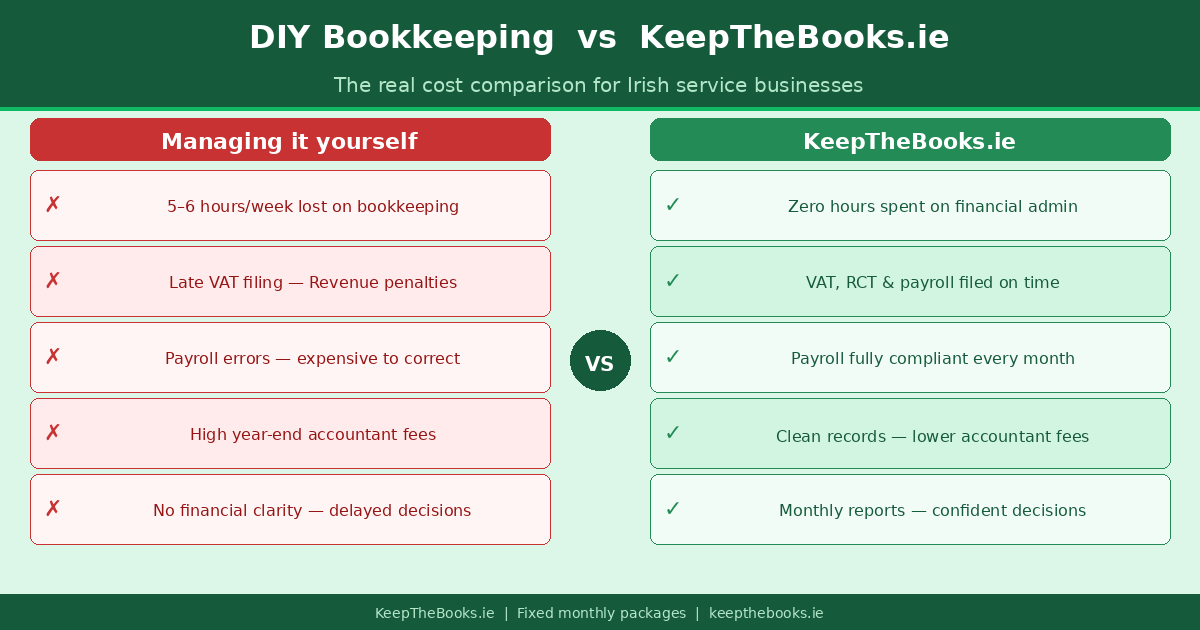
The direct costs are well documented. Revenue penalties for late VAT returns. Surcharges for missed RCT filings. Accountant fees inflated by disorganised records that take hours to untangle. Payroll corrections that are both expensive and time-consuming to fix. These costs are real, recurring, and entirely avoidable.
The indirect costs are less visible but just as significant. Five or six hours spent on bookkeeping each week is time not invested in clients or business growth. That is a high opportunity cost for any business owner. Beyond time, the bigger issue is decision-making quality. When your financial data is unreliable or out of date, you hesitate on decisions you should be making quickly and confidently. You delay hiring. You turn down work. You miss opportunities because you cannot see your numbers clearly enough to act.
Outsourcing bookkeeping to a professional removes all of these costs at once. For most Irish service businesses, the return on that investment is both immediate and measurable.
Explore Our Bookkeeping Services →
When Should a Service Business Hire a Bookkeeper?
There is no single revenue threshold that signals it is time to bring in professional bookkeeping support. But there are clear indicators.
You should be looking for a bookkeeper if you are regularly behind on invoicing, uncertain of your cash position, struggling to file VAT returns on schedule, spending several hours a week on financial admin, approaching your first hire, or planning to take on subcontractors for the first time.
For sole traders, professional bookkeeping support early on establishes clean, consistent records that make growth, funding applications, and year-end accountancy significantly more manageable. For limited companies, the requirements are more formal and the consequences of poor record-keeping are considerably more serious.
The businesses that face the most painful year-ends, and the ones that struggle most when applying for finance or preparing for a business sale, are almost always those that left bookkeeping too late.
What to Look for in a Bookkeeping Partner for Your Service Business
Technical competence is the baseline. The right bookkeeping partner must understand service-based business models retainer billing, project income, subcontractor management, payroll compliance, and the reporting needs of a growing SME.
Beyond technical skills, communication is everything. The right partner communicates proactively, responds promptly, flags issues before they escalate, and keeps you fully informed without you needing to chase for updates. For service business owners who are already managing a full client workload, that reliability is worth as much as the bookkeeping itself.
The best bookkeeping partners operate as a dedicated finance function embedded in your business fully across your numbers, aligned with your goals, and available when you need them. For Irish SMEs generating between €250,000 and several million in annual revenue, that level of professional financial support is a measurable competitive advantage.
Conclusion
Bookkeeping for service businesses is not a back-office formality. It is the financial backbone of how your business operates, grows, and ultimately succeeds. Accurate, current, and well-managed books give you the cash flow clarity to plan with confidence, the compliance record to avoid Revenue issues, and the financial visibility to make decisions that actually move the business forward.
If your bookkeeping is behind, disorganised, or simply not giving you the financial clarity your business needs, the time to address it is now not at year-end when the cost of catching up is at its highest, and not when Revenue comes looking.
Get in touch with KeepTheBooks.ie today →
FAQS
What is bookkeeping for service businesses?
Bookkeeping for service businesses is the ongoing process of recording and managing all financial transactions including client invoices, expenses, payroll, VAT returns, bank reconciliations, and monthly financial reporting. It ensures business owners have accurate, up-to-date financial data and remain fully compliant with Revenue requirements in Ireland.
Why do service businesses need professional bookkeeping?
Service businesses deal with variable income, multiple client invoice streams, payroll obligations, VAT compliance, and in many cases RCT requirements. Managing all of this accurately and consistently requires professional expertise. Errors in any of these areas carry direct financial penalties and create ongoing compliance risk.
How much does outsourced bookkeeping cost for a service business in Ireland?
Costs depend on the size of the business, monthly transaction volume, payroll requirements, and scope of services needed. Most professional bookkeeping firms offer fixed monthly packages, making it easy to budget. The investment is almost always offset by time saved, penalties avoided, and the value of accurate financial data for decision-making.
What is the difference between a bookkeeper and an accountant for service businesses?
A bookkeeper manages ongoing day-to-day financial records invoices, payroll, VAT, reconciliations, and monthly reports. An accountant typically handles year-end accounts, corporation tax, and strategic financial planning. Most service businesses need both. Well-maintained bookkeeping throughout the year makes the accountant's work more efficient and significantly reduces year-end fees.
Is Xero the best bookkeeping software for service businesses in Ireland?
Xero is the most widely adopted cloud accounting platform among Irish service firms and is highly recommended for its invoicing, payroll, VAT, and reporting capabilities. When paired with Dext for receipt management and Hubdoc for document collection, it provides a complete, efficient, and highly accurate bookkeeping environment.
What is catch-up bookkeeping for service businesses?
Catch-up bookkeeping is the process of bringing financial records fully up to date when they have fallen behind. This involves reconciling all transactions, processing outstanding invoices and expenses, and producing accurate reports covering the backlog period. Many service businesses require catch-up bookkeeping when engaging professional support for the first time.
How often should bookkeeping be updated for a service business?
Bookkeeping should be updated weekly where possible. At a minimum, it must be updated monthly. Leaving records any longer reduces financial visibility, makes reconciliation more time-consuming, and increases the likelihood of errors going undetected. Weekly updates provide the most accurate and reliable picture of your financial position at all times.
What financial records must service businesses retain in Ireland?
Service businesses in Ireland must retain all financial records for a minimum of six years. This includes sales and purchase invoices, bank statements, payroll records, VAT returns, RCT records where applicable, and all relevant contracts. A professional bookkeeper ensures records are properly maintained, accurately organised, and accessible when needed.